

Maximalist Wall Art: More, With Confidence
Twenty pieces can still read as one idea — if the colors repeat, the scales vary, and the gaps are planned like grout instead of left to chance.
Key Takeaways
- Maximalism is abundance composed, not clutter that got lucky: every piece needs a reason to be there, and pieces come down as well as go up.
- Repeat two or three anchor colors across the whole wall — that echo is what turns unrelated pictures into one composition with a pulse.
- Build the gallery wall on the floor first, photograph it, place the largest piece first, and keep one system underneath — limited frame finishes, constant mat width, or a shared palette.
- Separate patterns by scale — large beside small, with a stripe to mediate — and decide the palette before the pieces; a second deliberate exception is an argument, a third is an unchosen palette.
- Use the whole wall when height allows, with large pieces low and bold pieces high, and rehang wholesale now and then instead of endlessly patching.
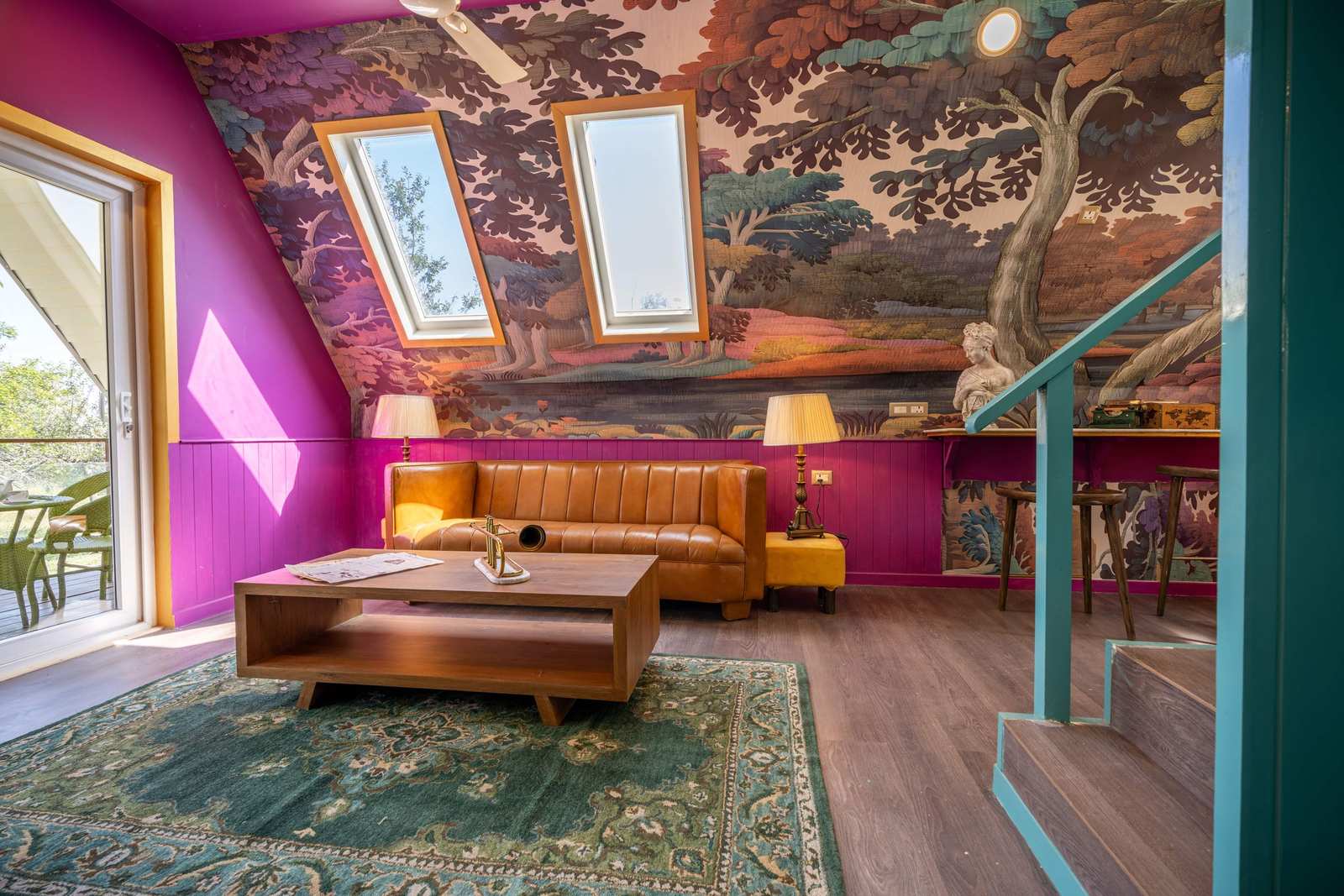
Maximalism is the style minimalism warned you about — and it has rules just as strict. Maximalist wall art is not clutter that got lucky. It is abundance arranged with confidence: many pieces, saturated color, pattern on pattern, layers built until the wall stops being a background and becomes the event. The difference between a maximalist wall and a mess is never the amount of stuff. It is whether the stuff was composed. This guide covers the composing — the few disciplines that let a wall hold twenty pieces and still read as one idea.
The maximalist wall art mindset: more, on purpose
Every decorating style is an answer to the question of how much is enough. Maximalism’s answer is: more than that — provided each addition is a decision. A maximalist wall grows the way a good bookshelf grows, by appetite and by eye, but it is edited like one too. Pieces come down as well as go up. The owner of a great maximalist room can tell you why each thing is there, even if the reason is only that its particular red was needed in that corner. If nothing on the wall has a reason, you do not have maximalism yet. You have storage.
Draw one boundary early. Maximalism is a way of arranging, not a family of objects — it can be built from any subjects and almost any palette, which is what separates it from the collected, traveled look of bohemian rooms, where the specific mix of global pattern and earthy color is the point. What holds any such mixture together — one unifying thread, chosen on purpose — is worked through in our guide to mixing art styles in one room. A maximalist wall might be all black-and-white photography, floor to ceiling, and still be maximalist: abundance is the style, whatever it is abundant with.
Maximalist wall art rules that keep more from becoming messy
Repeat a color, everywhere. The single most powerful tool on a crowded wall is a color that keeps showing up. Pick two or three anchor tones and make sure each appears in pieces scattered across the whole arrangement — a thread of cobalt here, a flash of it there. The eye reads those echoes as intention, and twenty unrelated pictures become one composition with a pulse. Vary the scale, deliberately. A wall of identically sized pieces reads as inventory; a wall with two or three large anchors, a middle register, and small pieces used as punctuation reads as music — the small pieces land like grace notes between the big chords.
Mix patterns by scale, not by hope. Pattern on pattern is the style’s signature pleasure and its easiest failure. The working rule is separation of size: a large-scale pattern can sit beside a small-scale one, and a stripe can mediate between them, but two patterns of the same scale and different motifs will fight at exactly the distance the room is viewed from. Leave breathing joints. Even a maximalist wall needs its gaps planned — consistent, narrow spacing between frames rather than random air. Crowding is a texture; gaps are the grout that makes the texture read.
Building the gallery wall
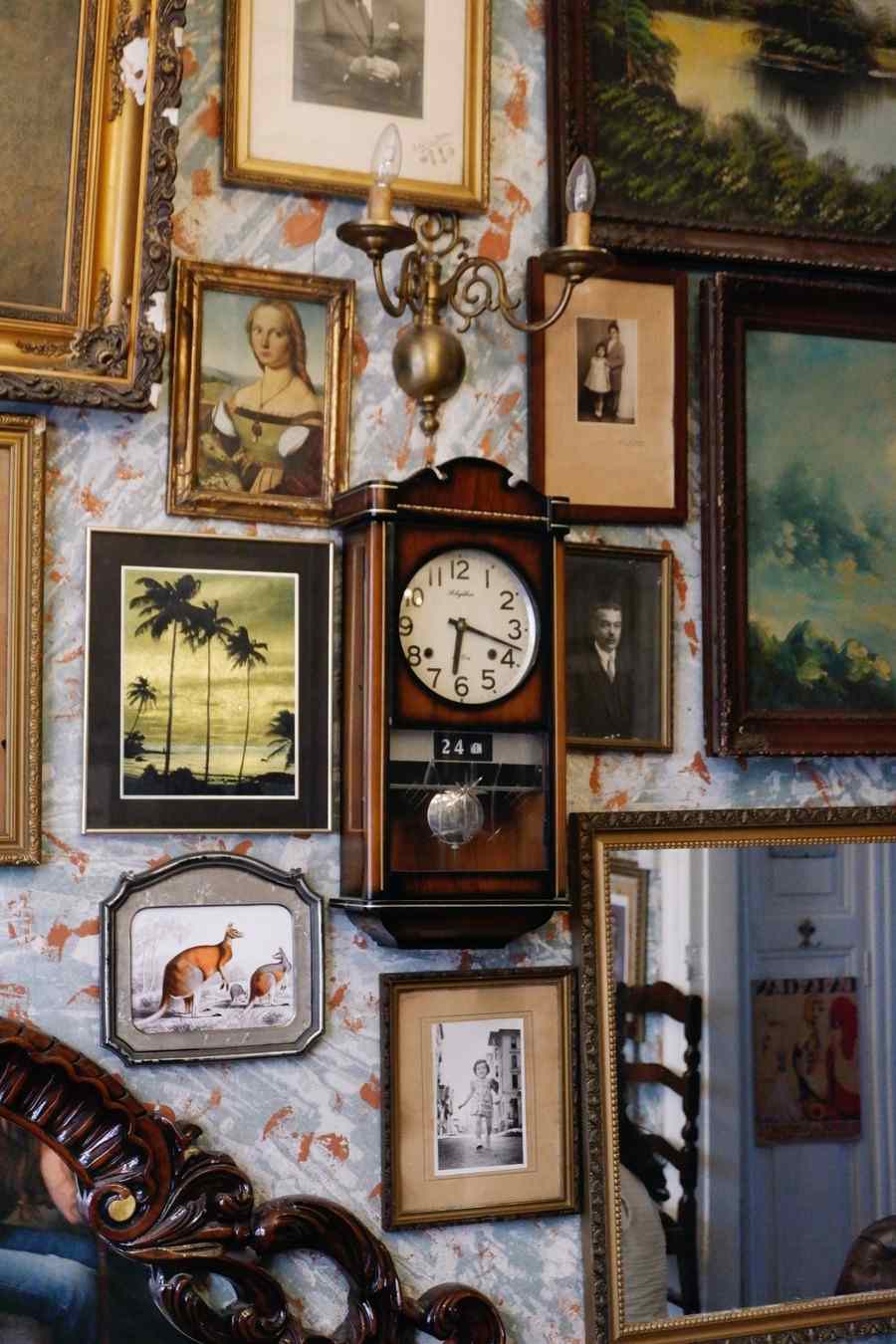
The maximalist instrument is the gallery wall — its alternative, one large statement piece, gets a fair hearing in our framework for choosing between a statement piece and a gallery wall— and its construction is unglamorous: layout first, holes second. Arrange the whole composition on the floor, photograph it, live with the photograph for a day, then transfer it to the wall with the largest piece placed first and the rest built outward. Start from a chosen center of gravity — not necessarily the middle of the wall, but the piece everything else will orbit — and keep the outer boundary of the arrangement decisive, whether that means a clean rectangular field of frames or a deliberate, stepped edge. A boundary is what tells a visitor the wall is finished rather than merely full.
Frames may mix — in this style they usually should — but mixing works when the finishes form a limited cast: black, brass, and natural wood, say, repeated across the wall, rather than nine unrelated experiments. Unify somewhere: if frames vary, mats can hold a constant width; if sizes vary wildly, a shared palette does the binding. A maximalist wall always has at least one system running underneath its freedom.
Color strategy: the jewel box and the controlled riot
Two palettes carry most successful maximalist rooms, and they work by opposite logic. The jewel box commits to depth: emerald, sapphire, oxblood, brass, walls painted dark enough that pictures glow against them like exhibits. In a jewel-box room the art can be wildly various because the envelope is so consistent — the dark ground is the system running underneath everything. The controlled riot keeps walls light and lets the art supply all the color, which demands more discipline from the anchor-color rule: with a white ground, unconnected colors read as noise much faster, so the repeated tones have to be chosen earlier and repeated more faithfully.
Either way, decide the palette before the pieces, not after. Maximalism’s reputation for spontaneity is mostly a myth told by its finished rooms; the walls that look effortlessly abundant were usually rationed from the start to a family of colors the owner loves enough to see forty times a day. If a candidate piece falls outside the family, it can still earn entry — as the single deliberate exception, placed where its strangeness registers as a solo. Two exceptions is an argument; three is a different, unchosen palette beginning without permission.
How high, how far: using the whole wall
Maximalist hanging ignores the polite convention that art lives in a band at eye level. The salon tradition — named for the crowded Paris exhibitions where pictures were stacked to the ceiling — treats the entire wall as the canvas, and in rooms with the height for it, a floor-to- ceiling arrangement is the style’s most dramatic register. It works when the composition is planned as one field rather than a stack of rows: large pieces low and at the center of gravity, smaller work filling upward, the topmost pieces chosen for boldness since detail is wasted at that distance. In ordinary rooms, a restrained version of the same idea — hanging a little higher and lower than instinct suggests, so the arrangement claims the wall rather than floating on it — gives most of the effect.
Where maximalism earns its keep
The living room is the natural stage — the room with the most wall, the most seating angles, and the social purpose that abundance flatters. A maximalist wall behind a sofa gives a room that collects people a backdrop that collects everything else. Stairwells and hallways are the second home of the style: transitional walls nobody sits facing can carry more density than a wall you contemplate for an evening, and the passing view of twenty pieces is a pleasure in itself. Bedrooms take a gentler dose — one dense wall, calmer at the head of the bed — and small rooms, contrary to instinct, often take maximalism beautifully, because a fully committed wall makes a small space feel curated rather than cramped.
When you go looking for pieces to build with, browsing the shop across styles at once is genuinely useful here — a maximalist wall is fed from every category, and the piece that completes an arrangement is often the one from a style you would never hang alone. Just keep the disciplines running as the wall grows: anchor colors repeated, scales varied, patterns separated, gaps planned. Maximalism is not the absence of restraint. It is restraint spent in a different currency — not on how much you hang, but on how carefully it all agrees to be there together.
Expect the wall to stay in motion. A maximalist wall art arrangement is closer to a garden than a monument: pieces arrive as gifts, finds, and upgrades, and each arrival reopens the composition. The owners who keep such walls joyful rather than stale do two unglamorous things — they rehang wholesale once in a while instead of endlessly patching, and they let pieces leave. A wall that can lose its weakest member without collapsing was built on a system; a wall that cannot was built on accumulation. Build the first kind, and more will always have somewhere to go. Maximalism is one of the sixteen styles mapped in this series’ plain-language field guide to wall art styles, where it stands as minimalism’s opposite pole.
More in Style Guides

Continue exploring: Style Guides guides · All guides