

How-To: Sizing, Hanging & Arranging
How High to Hang Pictures: Eye-Level Rules
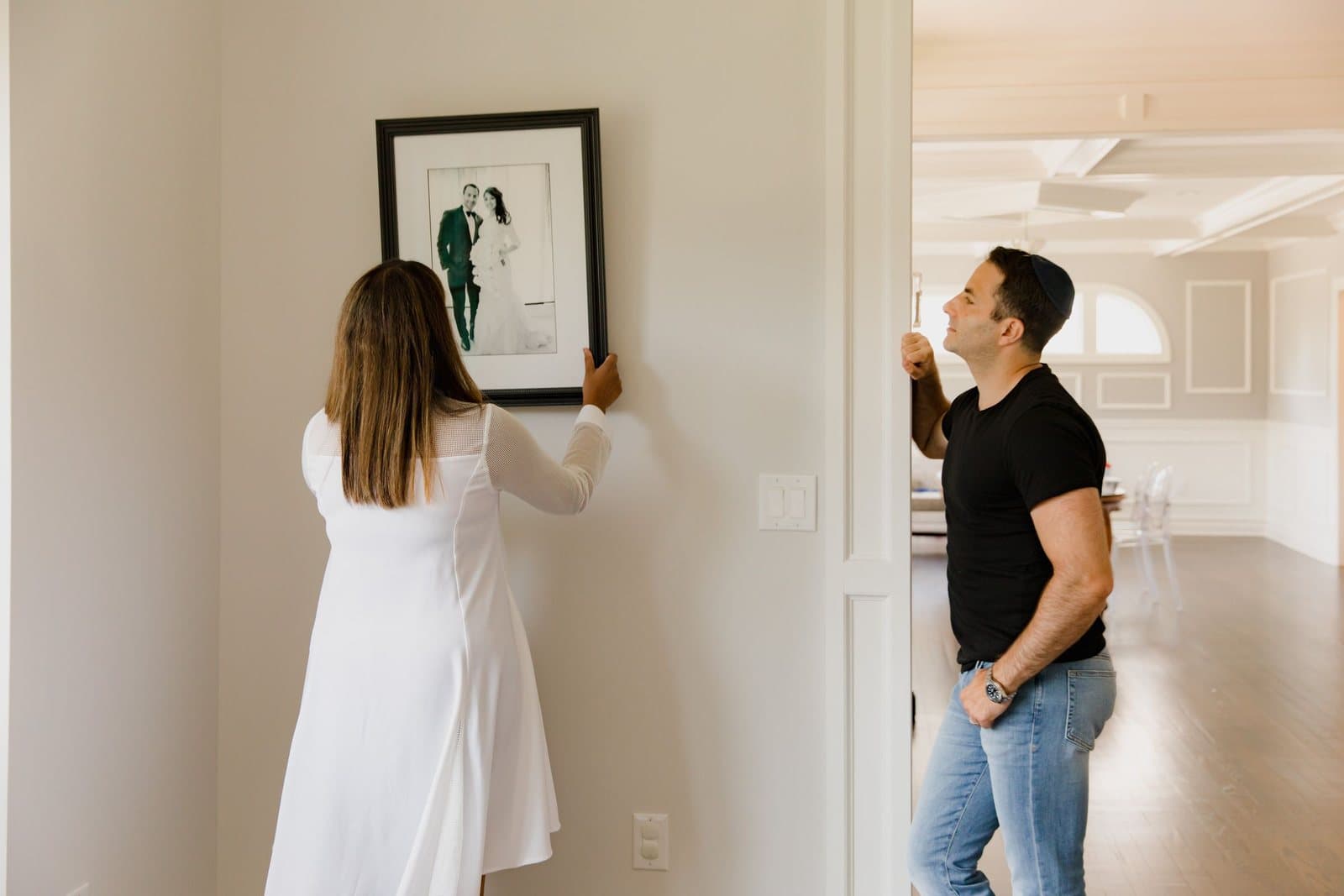
Heights stop being a guess once you measure to the middle of the piece instead of its top — and know when the furniture, not the floor, sets the line.
Key Takeaways
- Hang art so its center sits at 57 to 60 inches from the floor — average eye level; aligning centers, not tops, is what makes different sizes look calm together.
- Turn a center into a hook mark with one formula: hook height = center height + half the art's height minus the drop from the top edge to the D-ring or the taut wire's apex.
- Over furniture, skip the eye-level rule: the bottom edge should sit 6 to 10 inches above the sofa back, headboard, or sideboard top.
- On stairs, measure each center 57 to 60 inches straight up from the tread directly below it, so the centers climb parallel to the handrail.
- Center a group as one unit — its total rectangle, gaps included — and use the two-person method, with one person holding and the other judging from where the art will actually be viewed.
Of every question in decorating, “how high?” causes the most second-guessing — probably because the honest answer is a measurement, not a vibe, and nobody hands you the measurement at the hardware store. Here it is, with the exceptions that matter and the arithmetic that turns a target height into an actual mark on your wall. This guide owns one job: how high to hang pictures, the vertical placement of art. Widths and ratios live in the wall art size guide in this series; heights live here.
How high to hang pictures: the eye-level rule
The rule galleries and museums settled on long ago: hang art so its center sits at 57 to 60 inches from the floor — average adult eye level. Note what the rule measures. Not the top edge, which climbs higher with every larger size, and not the bottom edge, which drops. The center. Two pieces of very different sizes hung with their centers on the same line look calm together; hung with their tops aligned, they jitter. Sixty inches is the generous end of the range, 57 the classic gallery end; pick a number in that band and use it consistently through a room, and the walls will feel related even when the art is not.
Why does it work? Because a room’s real audience is a person standing in it, and eye level is where that person actually looks. Art centered there is met, not visited. The most common hanging mistake — pieces drifting up toward the ceiling, centers at 66 or 68 inches — asks every viewer to look up at the art as if it were signage. On a tall wall the temptation is strongest and the rule matters most: a wall can be ten feet tall, but its viewers are not, and the empty space belongs above the art, not below it.
From center to nail: the one formula
A target center is not yet a hole in the wall, because hooks do not sit at the center of anything. One formula bridges the gap, and it is worth writing on the painter’s tape: hook height = center height + half the art’s height − the drop, where the drop is the distance from the top edge of the frame down to the point that will actually rest on the hook — a D-ring, or the apex of a wire pulled taut the way it will hang. Which of those fittings should be on the back in the first place is a picture hanging hardware question, and it has its own guide.
Worked example, D-ring: a 24 by 36 inch piece, hung vertically, so 36 inches tall. Center target 58 inches puts the top edge at 58 + 18 = 76 inches. Its D-rings sit 2 inches below the top edge, so the hook mark goes at 76 − 2 = 74 inches. The bottom edge lands at 58 − 18 = 40 inches — comfortably above baseboard and furniture sight lines. Worked example, wire: a 30-inch-tall piece whose wire, pulled up taut between its two rings, peaks 3 inches below the top edge. Top edge at 58 + 15 = 73 inches; hook mark at 73 − 3 = 70 inches. Measure the drop with the wire under tension every time — a slack wire measured on the floor can sit an inch or more higher on the wall, and that inch is the whole rule.
Exception one: art over furniture
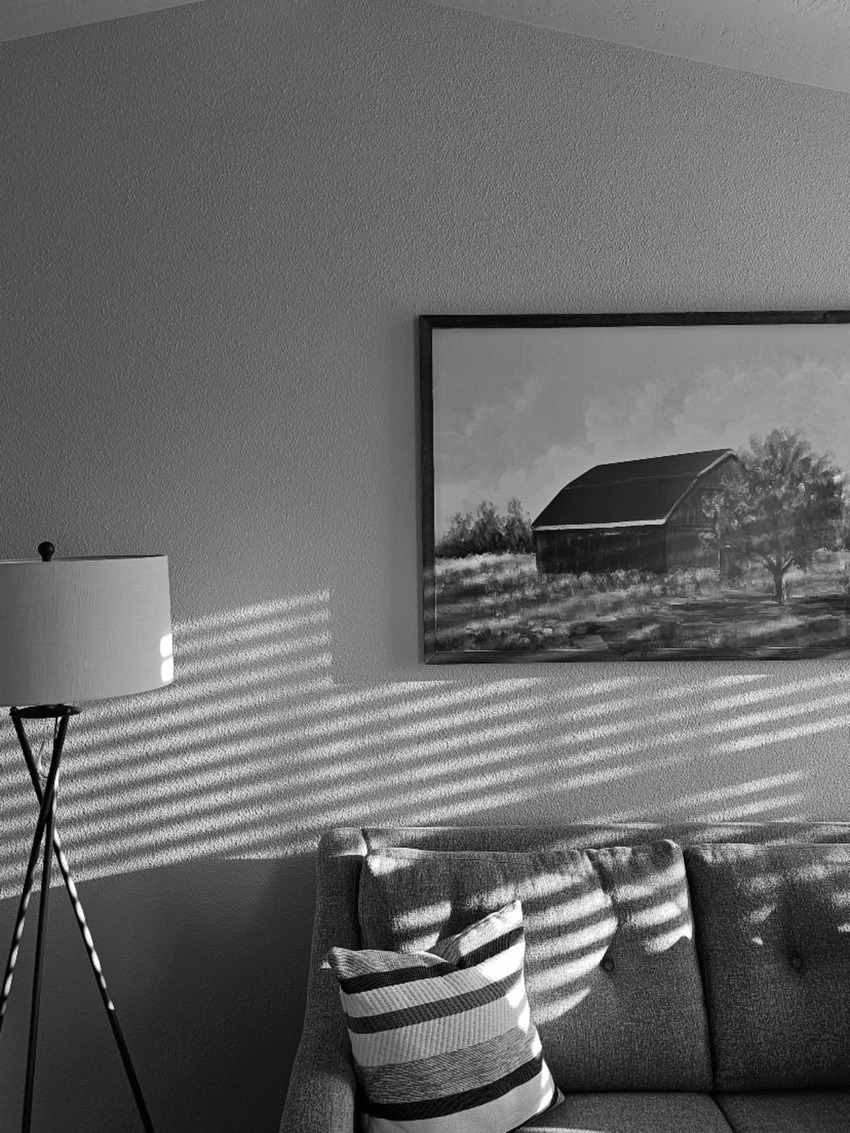
The eye-level rule governs bare walls. Over furniture, the furniture takes over: the bottom edge of the art should sit 6 to 10 inches above the top of the piece below it — the back of the sofa, the headboard, the sideboard surface. The arithmetic then lands wherever it lands, and it is supposed to. A sofa back at 34 inches, an 8-inch gap, and a 28-inch-tall piece put the bottom edge at 42 inches and the center at 56 — just under the standing range, and exactly right, because this wall’s audience is seated. Hang that same piece by the bare-wall rule instead and a visible gap of wall opens between sofa and art; the two stop belonging to each other, and the art reads as if it belongs to the ceiling. In the living room especially, art is furniture’s partner first and the wall’s second.
Exception two: rooms where everyone sits
Standing eye level is 57 to 60 inches; seated eye level is roughly 44 to 48 inches, because a chair seat is about 18 inches high and eyes sit about two and a half feet above the seat. In a dining room, where the art is studied for an hour from chairs, split the difference: centers around 48 to 54 inches feel engaged rather than looming. A 24-inch-tall piece centered at 51 inches tops out at 63 and bottoms at 39 — close enough to the table’s world to be part of the meal, high enough to clear chair backs and passing plates. The same logic, smaller, applies to art over a desk or a reading chair: lower the center a few inches toward the seated viewer, and stop there — art hung at true seated eye level looks stranded to anyone standing.
When the piece is taller than the rule expects
The center rule assumes a piece of ordinary height. Very tall pieces — a 48- or 60-inch vertical — bend it, because centering can push the top into the crown molding or drop the bottom into the furniture zone. Check both margins before committing. A 60-inch-tall piece centered at 58 runs from 28 inches at the bottom to 88 at the top: on an 8-foot (96-inch) ceiling that leaves 8 inches of headroom, which works. On a wall where a picture rail or deep trim sits at 84 inches, it does not — so slide the center down until the margins balance: centered at 56, the piece runs 26 to 86, still crowded; at that point the honest answer is that the piece wants a taller wall, and the rule has done its job by telling you before the hole was drilled. Short, wide pieces bend the rule the other way: a 12-inch-tall panoramic centered at 58 leaves its whole self in a narrow band, which is correct — panoramas hang over furniture or in rows, where the furniture rule and the shared center line take over.
Stairs and hallways: heights that travel
Stair walls scare people because the floor moves. The rule does not change; the reference point does. Each piece’s center should sit about 57 to 60 inches measured straight up from the tread directly below that center. Stand on the step, measure up the wall, mark, repeat for the next piece a few treads along. The centers then form a line that climbs parallel to the stairs — roughly parallel to the handrail — and a series hung this way reads as one calm procession instead of a scatter. Hallways are simpler: the standard eye-level line, undisturbed. The viewing distance is short, so centers a shade toward 57 keep pieces friendly at arm’s length, but do not lower art just because the hallway is narrow — height answers the viewer, not the corridor.
Groups: center the whole, not the pieces
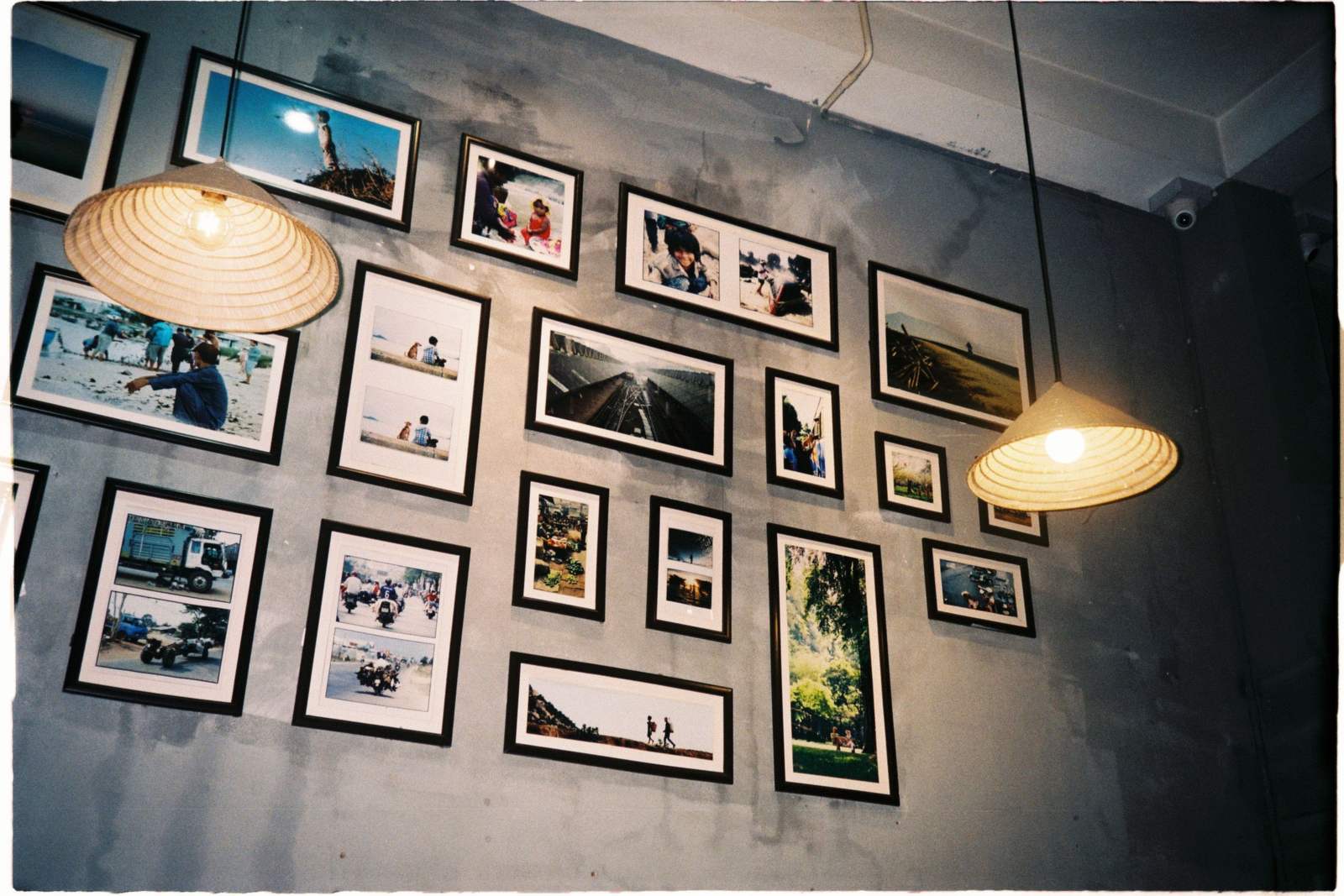
A grouping has one center: the middle of its total rectangle, gaps included. A cluster whose overall footprint is 40 inches tall, centered at 58, runs from 38 to 78 inches as a single unit — however the individual pieces distribute inside it. If you center each piece at 58 instead, the group’s outer edges sprawl and the arrangement reads top-heavy or adrift. Tape the full bounding rectangle first, find its center, and let the pieces arrange themselves inside the tape.
The two-person method
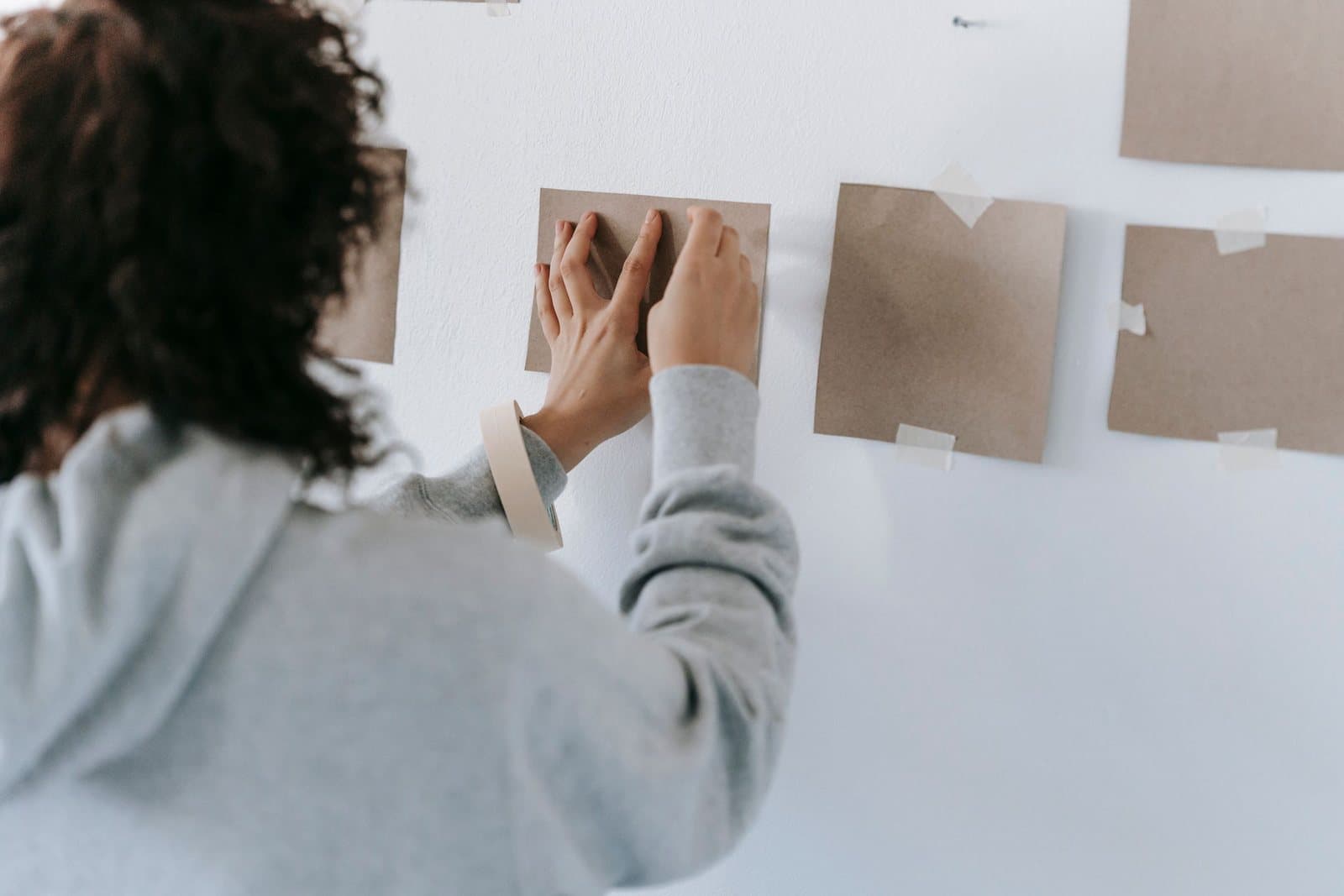
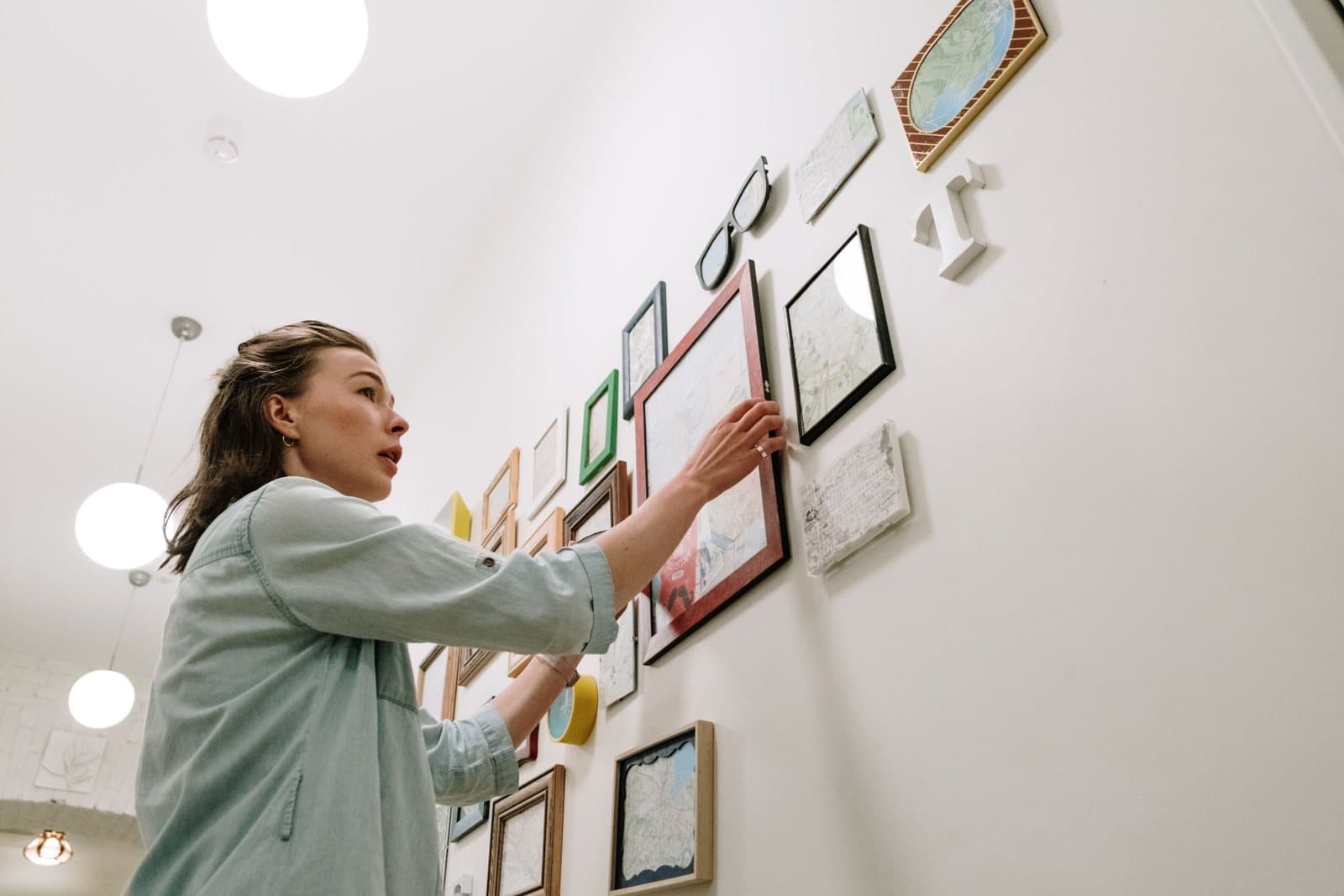
Heights are a two-person measurement, and the method is boring in the best way. One person holds the piece against the wall; the other stands where the art will actually be viewed from — across the room, or seated on the sofa — and calls the adjustments. Holder marks the top corners lightly in pencil or with tape. Then the piece comes down, the drop is measured on the frame, the formula runs once, and the hook mark is made from the corner marks. One hole, drilled or hammered once, at the computed height. Every extra hole in a wall is a height that was guessed; the computed ones are the ones that stay. Solo? The tape outline from the measuring guide does the holding for you — outline the footprint at the computed position, live with it a day, then hang once. One refinement for delicate paint: mark with a small cross of painter’s tape instead of pencil at the corners. The tape lifts away clean, and a tape cross is easier to see from across the room than a pencil tick when you step back for the seated check.
How high to hang pictures: the mistakes, collected
Hanging to the ceiling on a tall wall is the first of the wall art mistakes this series collects. Aligning tops instead of centers across a mixed wall. Measuring a wire slack. Centering over the wall when the sofa sits off-center — center on the furniture, always. And the subtlest: raising art over a low console or sideboard to hit 58 inches, which strands it in no-man’s-land between furniture and ceiling. The exceptions are not loopholes in the rule; they are the rule, applied to where the viewers are. When how high to hang pictures still nags at you after the math, the questions in our FAQ cover the situations readers ask about most — and the tape, as ever, gets the final vote.
More in How-To: Sizing, Hanging & Arranging
Continue exploring: How-To: Sizing, Hanging & Arranging guides · All guides