

Wall Art for Restaurants: Art That Earns
A dining room is read at table height, in warm light, for the length of a meal. This wall art for restaurants guide plans restaurant wall decor as a trade specification, not decoration.
Key Takeaways
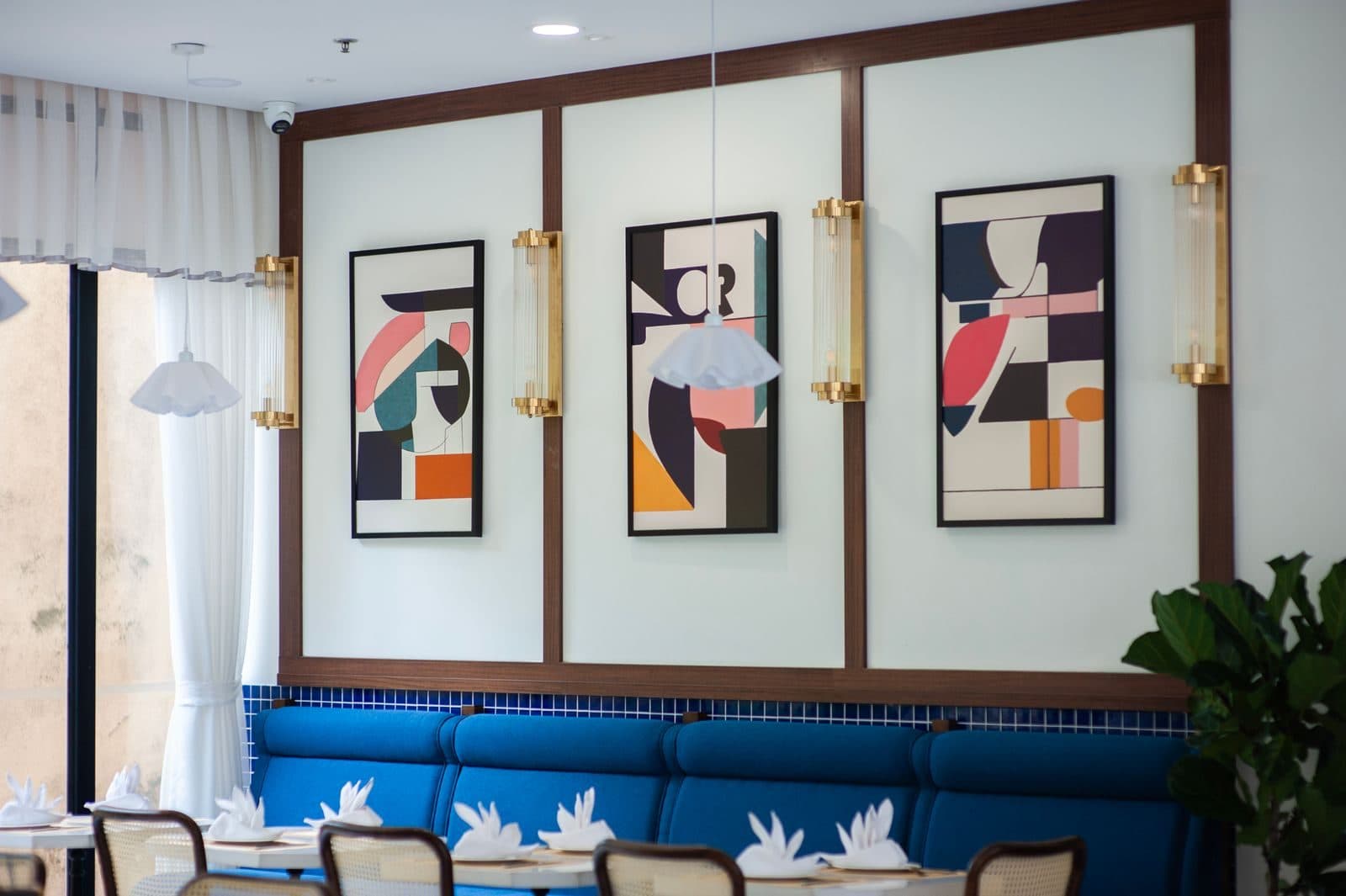
- Lead with local subjects: show the city, coast, or street the restaurant is actually in, carried from a signature main-room view through the bar and corridors at different scales.
- Specify sealed, wipeable formats for dining-room duty - metal and acrylic where steam, grease, and chair backs meet the wall - and avoid glass at chair-back height in traffic lanes.
- Hang for the seated eye: centers lower than living-room habit, one strong piece per sightline, checked for glare and for how the wall photographs from the worst seat in the room.
- Plan one scheme across every room - dining room, bar, private dining, entry, and corridor - on a single subject family and a short list of standardised sizes.
- Standardize sizes and keep a written record of room, subject, size, supplier, and date, so a damaged piece is a reprint and straight swap rather than a redesign.
Diners judge a dining room before the first plate lands, and the walls do much of the talking. Wall art for restaurants has a harder job than home art: it must set the room’s mood for people who will never meet the person who chose it, survive steam, grease, and chair backs, hold its level through daily cleaning, and — in the restaurants that get it right — give guests something they want to photograph. The rules are few, and mostly about format discipline and local pride.
Wall art for restaurants starts with atmosphere, not signage
A dining room is read at table height, in warm light, for the length of a meal. That single fact decides most of what belongs on its walls. The art is not there to explain the menu, announce the cuisine, or fill a gap the decorator ran out of ideas for; it is there to make a stranger feel, within a minute of sitting down, that this room was composed by someone. Restaurant wall decor that works behaves like the room’s lighting and music do: noticed as a whole, rarely examined piece by piece, and missed immediately when it is wrong or missing.
The line to hold is the one between atmosphere and signage. A picture chosen because it depicts the food is one step from a menu board; a picture chosen because it belongs to the place — its streets, its coast, its markets, its light — is decor with a point of view. Diners photograph one and ignore the other, and the photographed wall is the one that fills the next table.
Subjects diners sit with: local first, edible-adjacent second
Lead with local. A bistro should show its own city; a coastal dining room should show its coast. Local landscapes do three jobs at once in a commercial dining room: they tell the guest they are somewhere specific rather than anywhere, they give the room a signature image no chain competitor can copy, and they send guests home with the place still in their heads. Carry the local thread through the whole venue at different scales — the signature view large in the main room, its details and seasons in the bar and the corridor — and one place, explored properly, beats a world tour on every wall.
Food itself is the second subject, not the first, and it needs handling. Which food subjects stay art rather than signage — market scenes, ingredient studies, the vintage cafe poster tradition — is the question our guide to food and drink wall art adjudicates in full for kitchens and dining rooms at home; the same three checks apply at commercial scale, with the specificity check doubled. An image that could hang in any dining room on earth will make yours feel like any dining room on earth.
Formats that survive a dining room: steam, grease, and chair backs
A dining room is cleaned like a commercial space and treated like a borrowed one. Kitchen steam drifts, grease settles in a fine film, chair backs meet the wall a hundred times a week, and the cloth that wipes the tables will wipe the frames. Specify surfaces that can be wiped down without ceremony. Metal prints earn their place in this sector honestly: hard, sealed, and cleanable, with no frame lip to hold grease and no glass to break. Acrylic prints belong in the same durable family — sealed, wipe-clean, and untroubled by steam — and their gloss reads as intentional in bright, window-lit rooms where canvas would look soft.
Whatever the format, avoid glass at chair-back height in traffic lanes, and treat every lower edge as something a chair, a tray, or a highchair will eventually meet. Canvas and framed work have their place in the quieter zones — a private dining room, a chef’s counter wall nobody leans on — but the wall behind a banquette in a high-turnover room is a job for the toughest format you can specify. Art that survives a dining room is art whose failure modes were thought about in advance.
Wall art for restaurants at table height: scale, sightlines, and glare
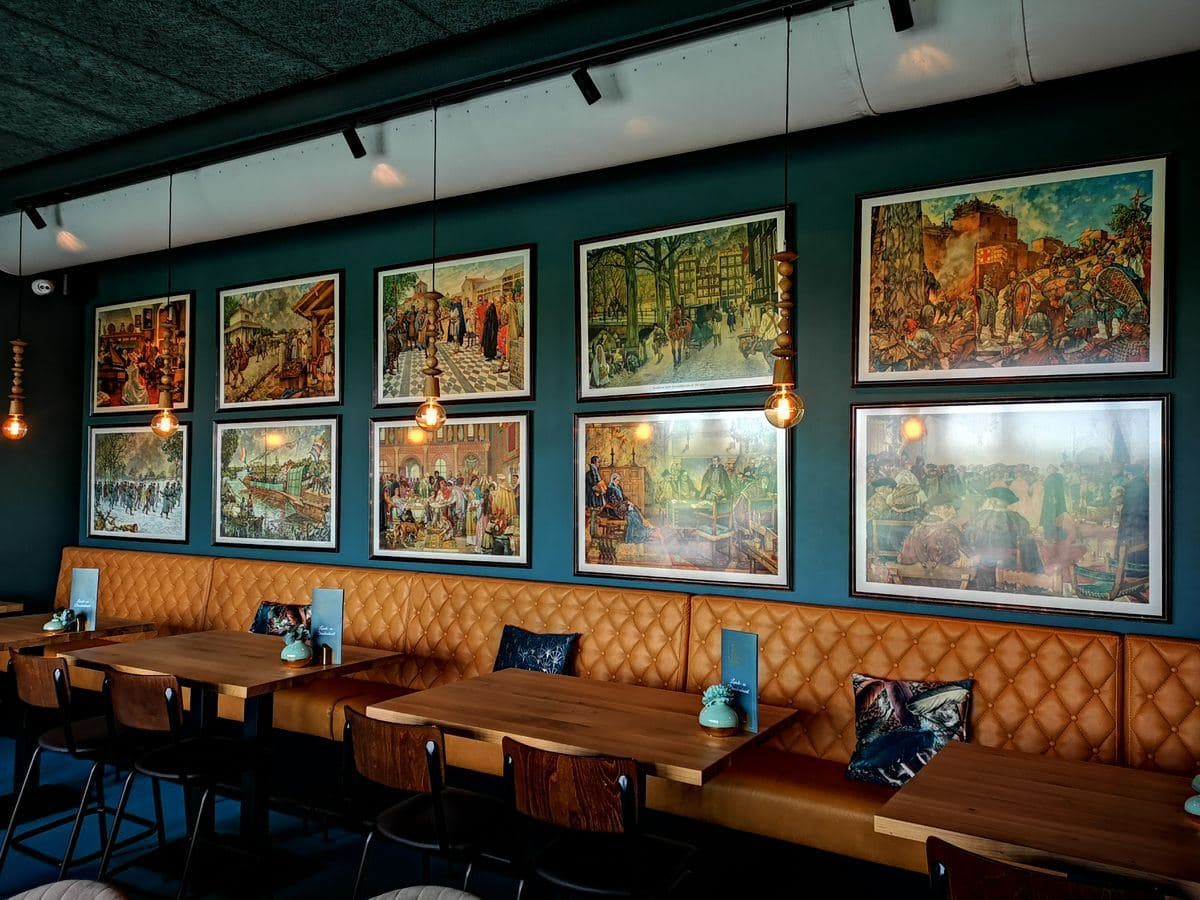
At home, pictures are hung for a standing viewer. In a restaurant, the viewer is seated for an hour or more, so hang for the seated eye: centers lower than living-room habit, close enough above a banquette that the piece reads as part of the seating rather than a sign above it. At home the same seated-viewer logic serves diners who are family; here the covers turn over, the chairs move, and the piece has to compose the room from every table, not just the best one.
Work the sightlines before you drill. Sit in the worst seat — by the kitchen door, facing the pass — and look at what that guest looks at for the length of a meal; that wall earns a real piece, not the spare. Then check glare: window light by day and pendants by night will find every glossy surface, and a piece that reads beautifully at install can white out at lunch. Finally, take the photograph test. Your dining room lives in listing photos and guests’ phones more than it lives in person, and large restaurant wall art that holds a wide photograph — one strong piece per sightline — is what survives the crop.
One venue, one scheme: dining room, bar, and the rooms in between
Few restaurants are one room. There is the dining room proper, the bar, a private dining room, the corridor to the restrooms that every guest walks, and the entry where waiting guests stand facing a wall with nothing else to look at. Plan one scheme across all of them: a single subject family and a short list of sizes, varied in scale and register — boldest in the entry, calmest where people sit longest. Planning one scheme across unlike rooms is the same problem, in a smaller building, as planning across floors, which our guide to wall art for offices works through for workplaces.
The venue words change; the discipline does not. Cafe wall art can sit closer and smaller, read at counter distance across a morning. Bar wall art works in lower light and can carry more contrast and more nerve. A bistro lives between the two. What none of them can afford is a different idea in every room: guests read inconsistency as carelessness, the one review a dining room cannot answer.
A second site is a specification test
The first restaurant is decorated; the second is specified. Opening another site — or refitting this one — is where undocumented choices send their bill: the piece nobody recorded, the size that was eyeballed, the supplier nobody wrote down. The answer is not chain anonymity. It is a written scheme tight enough to repeat and loose enough to localise: standardised sizes and formats across sites, the signature subject re-shot or re-chosen for each neighbourhood, so the second dining room is recognisably the same restaurant and just as recognisably on its own street.
Bulk wall art for restaurants belongs in that written scheme from the start: the sizes list, the format list, and the reorder route, settled before opening week rather than negotiated during it. A scheme that exists on paper can be priced, compared, and handed to a fit-out crew; a scheme that exists in the owner’s head gets re-decided at every site, at opening-week prices.
Replacements and records: keeping the wall the photograph promised
Pieces will be damaged eventually — that is not a risk to eliminate but a cost to make small. Standardise a short list of sizes for the whole venue and stick to it, so any room’s replacement is a reprint at a known size, not a fresh design decision. Keep a written record — room, subject, size, supplier, date — and keep the source files. Guest venues and dining venues share this discipline entire, and its fullest statement is our guide to hospitality wall art, written for hotels and rentals facing the same promise: the room in the photograph is the room the guest walks into.
Build the inspection into a calendar you already keep. Monthly, walk the room with the record in hand: pieces level, fixings firm, surfaces wiped, fading noted against the replacement list. The dining rooms whose art always looks new are not the ones that bought better pictures — they are the ones that look, on a schedule.
Working with a supplier
Choosing the pictures is the visible half of the job. The other half is specifying them like a trade buyer — finished sizes in writing, a proof judged in the room’s own light, lead times set against the opening date — and that discipline is exactly what our guide to designer wall art sourcing sets out for any print partner, on any commercial scheme. If you are fitting out more than one room, ask the trade questions up front as well — how the trade program handles multi-room orders, reprints, and replacements — because you are not buying pictures. You are buying the ability to keep a dining room looking identical to its photographs, service after service.
Local subjects, hard formats, table-height hanging, and a replacement record: that is the entire discipline of wall art for restaurants. Do those four things and your guests will do your marketing for you, one photographed wall at a time. The same discipline extends to the smaller surfaces too — restaurant wall decor for the bar, the pass, and the corridor, chosen to the same standard as the dining room walls.
More in Trade & Designer B2B

Continue exploring: Trade & Designer B2B guides · All guides