

Wall Art for Waiting Rooms: A Trade Guide
A waiting room is read from a chair, for an open-ended wait, in bright light. This wall art for waiting rooms guide plans waiting room wall decor as a trade specification, not decoration.
Key Takeaways
- Lead with calm nature subjects - landscapes, coast, and gardens a seated stranger can look at for twenty minutes and find neither boring nor confronting - and exclude clinical imagery, diagrams, and staring faces.
- Specify sealed, wipe-clean formats for the cleaning rota - metal and acrylic first - with no glass anywhere chairs, bags, and children meet the wall at picture height.
- Hang for the seated eye: centers below standing habit, one strong piece on the wall the chairs actually face, checked for glare from the chair rather than from the ladder.
- Plan one scheme across reception, waiting room, and corridor on a single subject family and a short list of standardised sizes, with the children's corner livelier in subject but identical in format discipline.
- Keep a written record of room, subject, size, supplier, and date, and check the walls on the cleaning rota itself, so a damaged piece is a reprint rather than a redesign.
A waiting room is the one room every visitor sits in, faces the same wall in, and has nothing to do in but look. Wall art for waiting rooms has a harder job than home art: it is read from a chair, at close range, for an open-ended wait, by people who did not choose the room, the chair, or the wait — and it has to survive being wiped down on a cleaning rota for years while it does it. The rules are few, and mostly about subjects that repay long looking and formats that tolerate being cleaned.
Wall art for waiting rooms starts with the seated stranger
Design the room from the chair, not from the door. The person who matters is already seated, facing one wall, with time to study it in a detail no gallery visitor ever reaches. Waiting room wall decor that works behaves like a good magazine in the rack: it gives the eye somewhere to go, asks nothing of the reader, and does not repeat the room’s business back at them. A wall that does that reads as care; a blank wall reads as an afterthought — and the waiting room is where a practice is judged before anyone has been seen.
That also settles what the art is not. It is not signage: services, hours, and instructions already have their frames by the desk. The moment the pictures join in — a poster explaining a treatment, a diagram of the thing the visitor is waiting to have done — the wall stops being decor and becomes homework. Keep the jobs in separate frames, and let the art be the one thing in the room not telling anybody anything.
Subjects for a long look: nature first, nothing confronting
Lead with nature. Landscapes, coast, gardens, and water repay the hundredth minute of looking without wearing out: there is always another distance in a landscape, another season a garden can be read in. Local landscapes do the extra job they do in every trade room — they tell the visitor they are somewhere specific, in a practice rooted in its own place, rather than in any waiting room on earth. Carry one subject family through the whole practice at different scales: the signature view large on the wall the chairs face, its details and seasons in the corridor on the way through.
Then apply the exclusions, which matter as much. No clinical imagery: no anatomy, no diagrams, no before-and-after photographs — a waiting room is the last place anyone needs the procedure illustrated. No staring faces at seated eye level. And ration text hard: a typographic piece charming for ten seconds is an instruction by the twentieth minute. Clinic waiting room art, dental waiting room art, medical office wall art — the venue words change, but the subject test is the same: could a stranger look at this for twenty minutes and find it neither boring nor confronting? That is the whole brief.
Formats that survive a waiting room: wiped often, touched constantly
A waiting room is cleaned like a public space, because it is one. Chairs are wiped, walls are wiped, and the frames are wiped with whatever is already in the cleaner’s hand, on a rota that runs daily in busy practices. Specify surfaces that take that without ceremony. Metal prints earn their place here honestly: hard, sealed, and cleanable, with no frame lip to hold grime and nothing to crack. Acrylic prints belong in the same family — a sealed, wipe-clean face that shrugs off the rota — and their smooth finish reads as deliberate in the bright, even light most waiting rooms are lit with.
Keep glass out of the waiting room. Not as a style preference: where chairs scrape, children climb, and bags meet the wall at picture height, a glazed frame is a breakage waiting for its moment, and its reflections fight the lighting the rest of the time. Secure fixings are the other half of the same specification — pieces should sit flush and firm, removable by the practice’s own people with a tool, not by anyone passing. Canvas has its place in quieter corners — a consultation room, a staff room — where traffic does not back chairs into it.
Wall art for waiting rooms at seated eye level: scale and sightlines
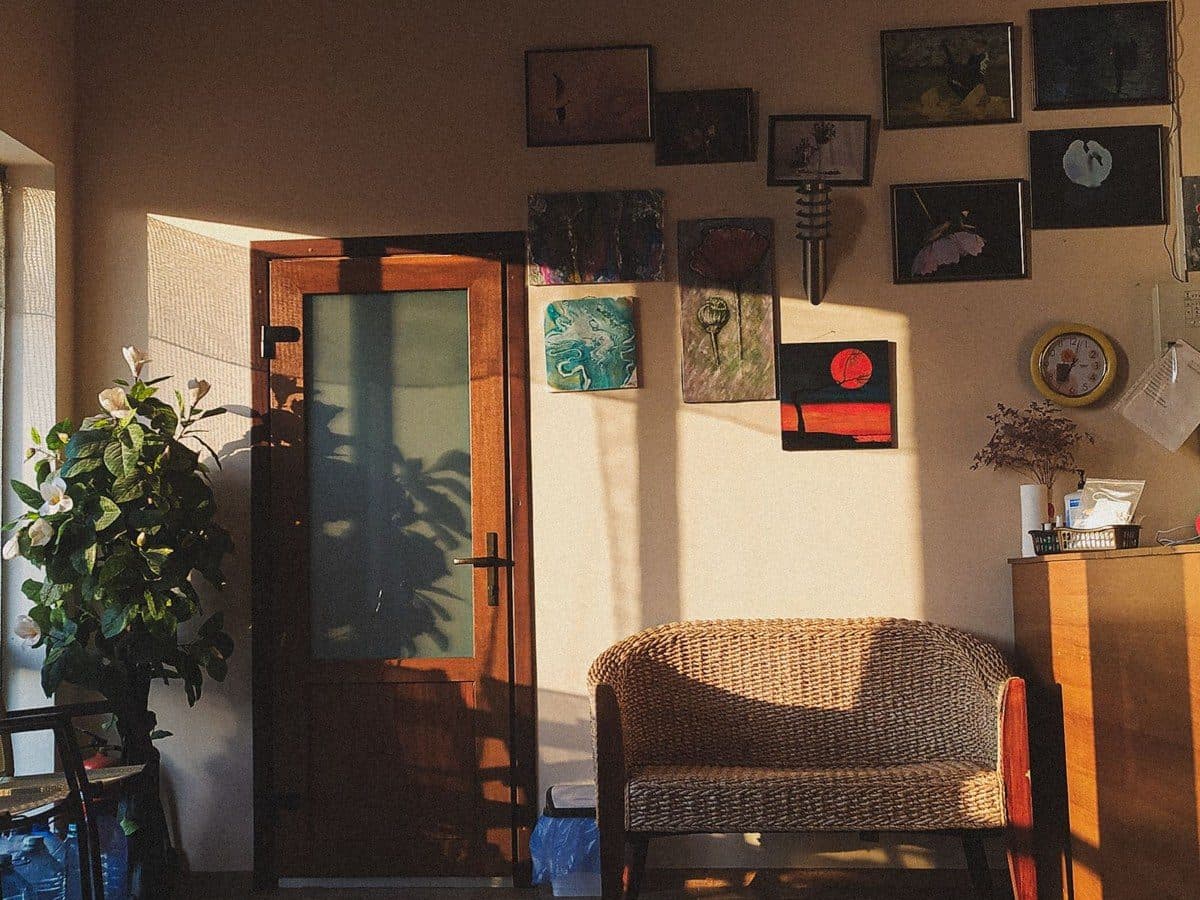
Hang for the seated eye. A waiting visitor’s eye level is a chair’s height plus a slouch, well below the standing center line that living-room habit reaches for — so centers come down, and the piece sits close enough above the chair backs to read as part of the seating rather than a sign mounted over it. Work out which wall the chairs actually face and spend the scheme there first; the wall behind the seated row is seen only by staff and the door, and it is where the spare and the small belong.
Scale for the longest wait, not the longest wall. One strong piece per sightline beats a scatter of small ones: small pictures invite close reading they cannot reward, and a row of little frames reads as clutter by the second visit. Check glare from the chair, not the ladder — windows face chairs as often as desks, and a glossy surface can white out at midday. Finally, take the photograph test: the room lives in the practice’s listing photos, and that wall is the first waiting room every new visitor sits in.
One practice, several rooms: reception, corridor, and the way through
Few practices are one room. There is reception, where the waiting happens standing; the waiting room proper; the corridor every visitor walks to the treatment rooms; and often a smaller corner — a few chairs by a window, a children’s corner with its own small table. Plan one scheme across all of them: a single subject family and a short list of sizes, calmest and largest where people sit longest, brighter and smaller in the rooms people only pass through. Planning one scheme across unlike rooms is the same problem, in a smaller building, as planning across floors, which our guide to wall art for offices works through for workplaces and their reception areas.
The children’s corner earns one specific decision: its pictures can be livelier and lower, at a child’s seated eye level, but they take exactly the same format discipline — sealed, wipe-clean, no glass, secure fixings — because no wall in the building is cleaned more often. Consistency of format with variety of subject is what makes small rooms read as one practice.
A second practice is a specification test
The first waiting room is decorated; the second is specified. Opening another location — or refitting this one — is where undocumented choices send their bill: the size that was eyeballed, the supplier nobody wrote down, the subject chosen from a screen nobody kept. The answer is a written scheme tight enough to repeat and loose enough to localise: standardised sizes and formats across sites, the signature subject re-chosen for each neighbourhood, so the second waiting room is recognisably the same practice and just as recognisably on its own street.
The scheme also keeps waiting room wall decor honest over time. The catalogue will argue for a refresh at every refit; the record argues back — what is on each wall, at what size, from which supplier — and a change becomes a decision made once, on paper, instead of a drift.
Replacements, records, and the cleaning rota
Pieces in a public room will eventually be scuffed, faded, or damaged — that is not a risk to eliminate but a cost to make small. Standardise a short list of sizes for the whole practice and stick to it, so any room’s replacement is a reprint at a known size, not a fresh design decision. Keep a written record — room, subject, size, supplier, date — and keep the source files. Guest venues run the same discipline at a faster tempo, and its fullest statement is our guide to hospitality wall art, written for hotels and rentals keeping the same promise: the room in the photograph is the room the visitor walks into.
Build the check into the rota that already exists. The room is cleaned on a schedule; add the walls to it — pieces level, fixings firm, fading noted against the replacement list, on the same round that touches every chair. The waiting rooms whose art always looks new are not the ones that bought better pictures. They are the ones whose walls are looked at, on a schedule.
Working with a supplier
Choosing the pictures is the visible half of the job. The other half is specifying them like a trade buyer — finished sizes in writing, a proof judged in the room’s own light, lead times set against a refit date the practice cannot move — and that discipline is exactly what our guide to how interior designers source wall art sets out for any print partner, on any commercial scheme. If you are fitting out more than one room, ask the trade questions up front as well — how the trade program handles multi-room orders, reprints, and replacements — because you are not buying pictures. You are buying the ability to keep a waiting room looking identical to its photographs, clean after clean.
Calm nature subjects, sealed formats, seated eye level, and a record that survives the refit: that is the entire discipline of wall art for waiting rooms. Do those four things and the room stops apologising for the wait — it simply gives the wait somewhere decent to sit. The same calm applies beyond the waiting room itself — waiting room wall decor for the reception desk and the corridor, chosen to the same seated-eye-level standard as the main wall.
More in Trade & Designer B2B
Continue exploring: Trade & Designer B2B guides · All guides